Your browser does not support JavaScript!

Questions and Answers

Enzymes: How They Work and What Affects Them

1.
People with lactose intolerance get stomach cramps after drinking milk because their gut makes too little of one enzyme. Which enzyme is it?
lactase
Explanation
Enzymes are usually named after their substrate with the ending -ase, while sugars end in -ose. Lactase splits lactose, the sugar in milk, into glucose and galactose.
Match each enzyme with the substance it breaks down.
2.
lipase
fats and oils
3.
sucrase
table sugar
4.
protease
gluten in wheat flour
5.
cellulase
cotton and paper fibers
Explanation
Lipase breaks down lipids (fats and oils), sucrase breaks down sucrose (table sugar), protease breaks down proteins such as gluten, and cellulase breaks down cellulose, the fiber in cotton and paper. Starch has no pair: it is broken down by amylase, which is not on the list.
6.
Put the steps of one enzyme reaction in the order they happen.
The substrate bumps into the enzyme and slips into the active site.The enzyme holds the substrate so that its bonds break more easily.The substrate is turned into products.The products are released from the active site.
Explanation
The substrate first has to reach the active site. Once it is held there, its bonds are strained, it is turned into products, and the products leave, freeing the active site for the next substrate molecule.
7.
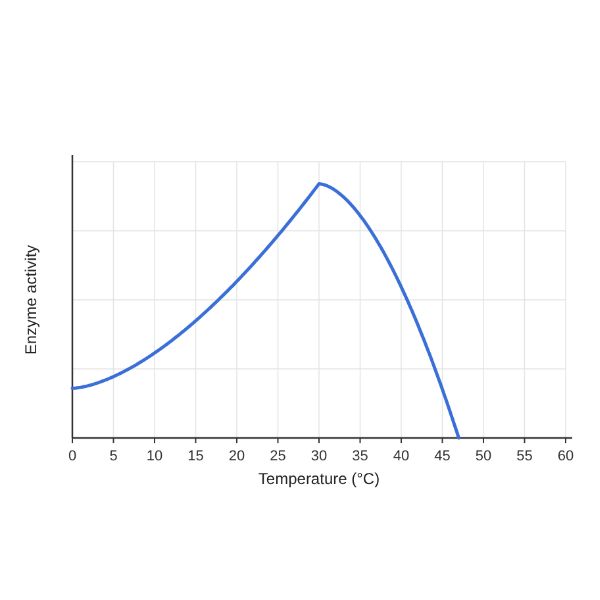
Based on the graph, what is the optimal temperature for this enzyme?
30°C
Explanation
The optimal temperature is where the curve reaches its peak, so the enzyme works fastest there. Above it, the rate drops quickly because the enzyme starts to lose its shape.
Which statements about enzymes and temperature are true?
8.
Food keeps longer in a fridge partly because cold slows down the enzymes that make it spoil.
True
9.
Freezing destroys enzymes, so thawed frozen vegetables have no working enzymes left.
False
10.
A lizard is sluggish on a cold morning partly because the enzymes in its muscles work slowly.
True
11.
Above the optimum temperature, the rate falls more steeply than it rises below the optimum.
True
Explanation
Cold slows enzymes down but does not destroy them, which is why food lasts longer in a fridge and vegetables are briefly boiled (blanched) before freezing. Above the optimum, the enzyme loses its shape, so the rate falls much more steeply than it rose.
12.
Fill in the gaps.
Most human enzymes work best at about 37°C, while Taq polymerase, taken from bacteria that live in hot springs, works best at about 72°C.
Explanation
Enzymes are adapted to where they work: human enzymes to body temperature, and Taq polymerase to the hot springs of Yellowstone, where Thermus aquaticus bacteria live. Because it survives near-boiling heat, it is used in PCR, a lab method that cycles up to about 95°C.
13.
Every enzyme has an optimum pH. Why does it stop working when the pH moves far from this value?
The pH changes the charges on its amino acids, so the active site loses its shape.
Explanation
Hydrogen ions change the electric charges on amino acid side chains. The bonds that hold the active site in shape are disrupted, so the substrate no longer fits.
14.
A biological laundry detergent contains proteases. Which stains do these enzymes help remove?
blood, egg white
Explanation
Proteases break down proteins: hemoglobin in blood and albumin in egg white. Olive oil needs a lipase, and red wine is colored by plant pigments, not proteins.
An enzyme is mixed with its substrate in a test tube at constant temperature and pH. Which statements are true?
15.
At low substrate levels, adding more substrate makes the reaction faster.
True
16.
Once every active site is busy, adding more substrate still makes the reaction faster.
False
17.
With plenty of substrate, doubling the amount of enzyme roughly doubles the reaction rate.
True
18.
As the substrate gets used up, the reaction gradually slows down.
True
Explanation
With little substrate, many active sites stand empty, so more substrate speeds things up. Once all active sites are busy, the enzyme is saturated: only more enzyme helps. As substrate runs out, the reaction slows down.
19.
An enzyme speeds up a reaction in a cell. Compared with the same reaction without the enzyme, what stays the same?
which products are formed, the total energy released by the reaction
Explanation
An enzyme only lowers the energy barrier, so the same products form sooner. The products and the total energy released depend on the reaction itself, not on the enzyme.
20.
Many B vitamins, such as niacin and riboflavin, are needed only in tiny amounts. What does the body use them for?
To make coenzymes, small molecules many enzymes need to work.
Explanation
B vitamins are turned into coenzymes, small organic helpers that many enzymes need to work (niacin into NAD, riboflavin into FAD). They are reused over and over, so tiny amounts are enough.
21.
In many cells, the final product of a chain of enzyme reactions can bind to the first enzyme in the chain and slow it down. What does this achieve?
The cell does not waste resources making more product than it needs.
Explanation
This is feedback inhibition. When the product builds up, it switches off the start of its own pathway, so the cell does not waste resources; when the product runs low, the first enzyme works again.
22.
Diet sodas carry the warning “Phenylketonurics: contains phenylalanine.” Why must people with phenylketonuria (PKU) limit this amino acid?
They lack a working enzyme that breaks it down, so it builds up to harmful levels.
Explanation
In PKU, the enzyme that converts phenylalanine into tyrosine does not work. Phenylalanine then builds up in the blood and can damage the brain, so patients follow a low-phenylalanine diet.
Match each enzyme with its job when a cell copies its DNA.
23.
helicase
pulls apart the two strands
24.
DNA polymerase
adds nucleotides to build a new strand
25.
DNA ligase
seals the gaps between pieces of new DNA
Explanation
Helicase unzips the double helix, DNA polymerase adds nucleotides to build each new strand, and DNA ligase seals the gaps between pieces of new DNA. Laying down short RNA starters has no pair: that is the job of primase, which is not on the list.
Which statements about enzymes are true?
26.
RuBisCO, which captures carbon dioxide in photosynthesis, is thought to be the most abundant protein on Earth.
True
27.
One molecule of carbonic anhydrase can process about a million substrate molecules per second.
True
28.
Luciferase is the enzyme that makes fireflies glow.
True
29.
Every enzyme works only inside the cell that made it.
False
Explanation
RuBisCO, which fixes carbon dioxide in photosynthesis, is thought to be the most abundant protein on Earth, and carbonic anhydrase is one of the fastest enzymes known. Many enzymes work outside the cells that made them, such as digestive enzymes in the gut.
30.
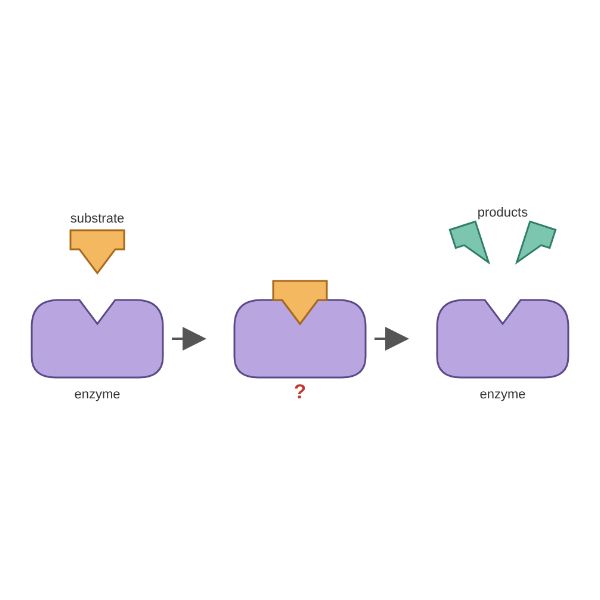
The picture shows an enzyme with its substrate bound in the active site. What is this temporary combination called?
enzyme-substrate complex
Explanation
While the substrate is held in the active site, enzyme and substrate form an enzyme-substrate complex. It lasts only until the products are released.