Questions and Answers
Proteins and Enzymes: Structure and Function
1.
Which type of bond joins amino acids one after another into a protein chain?
peptide bond
Which statements about amino acids are true?
2.
Proteins in the human body are built from 20 standard amino acids.
True
3.
Glycine, the smallest amino acid, has just a hydrogen atom as its side chain.
True
4.
Amino acids differ from one another only in their side chain, also called the R group.
True
5.
The human body can make all 20 amino acids itself, so none of them must come from food.
False
6.
Digestive enzymes break the proteins in food down into single amino acids. Which molecule is used up each time one bond between two amino acids is broken?
water
7.
A protein chain is made of 50 amino acids. How many bonds join one amino acid to the next along this chain?
49
Match each example with the level of protein structure it describes.
8.
primary structure
Human and pig insulin differ by just one amino acid in their sequence.
9.
secondary structure
Stretches of a keratin chain in hair coil into spring-like helices held by hydrogen bonds.
10.
tertiary structure
A lysozyme chain folds into a compact ball, held in shape partly by four disulfide bridges.
11.
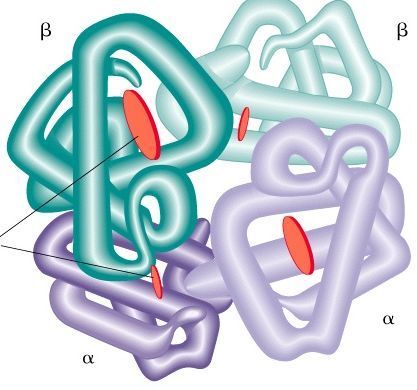
antibody (IgG), catalase
Match each protein with the job it does in the body.
12.
insulin
tells body cells to take up glucose from the blood
13.
collagen
makes tendons and skin strong and tough
14.
myosin
pulls on actin filaments so muscles contract
15.
antibodies
bind to viruses and bacteria and mark them for destruction
Which statements about proteins are true?
16.
The order of amino acids in a protein is coded by a gene in the cell's DNA.
True
17.
Proteins contain nitrogen, which typical carbohydrates and fats do not.
True
18.
The body stores extra amino acids for later, the same way it stores extra fat.
False
19.
A protein's function depends only on which amino acids it contains, not on its shape.
False
Which statements about enzymes are true?
20.
An enzyme molecule is used up after it speeds up one reaction.
False
21.
Enzymes speed up reactions by lowering the activation energy needed to start them.
True
22.
Most enzymes are proteins, but some RNA molecules can also act as catalysts.
True
23.
Enzymes make reactions possible that could never happen on their own.
False
Catalase in your liver breaks down harmful hydrogen peroxide into water and oxygen. Match each part of this reaction with its role.
24.
catalase
enzyme
25.
hydrogen peroxide
substrate
26.
water and oxygen
products
27.
the pocket on catalase where hydrogen peroxide binds
active site
28.
Amylase in saliva breaks down starch but has no effect on the proteins in the same bite of food. Why?
Only starch has the right shape to fit amylase's active site.
29.
According to the induced fit model, what happens when a substrate binds to an enzyme?
The active site changes shape slightly to fit tightly around the substrate.
30.
Fill in the gaps.
Pepsin, made in the stomach, works best at about pH 2, while trypsin, made in the pancreas, works best at about pH 8.
Which statements about enzyme inhibitors are true?
31.
A competitive inhibitor fits into the active site and blocks the substrate from binding.
True
32.
Adding a lot more substrate can weaken the effect of a competitive inhibitor.
True
33.
A noncompetitive inhibitor works by binding to the substrate instead of the enzyme.
False
34.
Aspirin relieves pain by blocking an enzyme the body uses to make inflammation signals.
True
35.
A gelatin dessert made with fresh pineapple never sets, but one made with canned pineapple sets normally. Why?
Canning heats the fruit, which destroys an enzyme that breaks down gelatin.
Which statements about denaturation are true?
36.
Frying an egg denatures proteins in the egg white, which is why it turns white and firm.
True
37.
Denaturation breaks the peptide bonds, so the protein falls apart into single amino acids.
False
38.
Stomach acid denatures proteins in food, which makes them easier for enzymes to digest.
True
39.
A boiled egg white turns clear and runny again once it cools down.
False